Learn / Cost & Procurement
What It Costs to Get a Container Gym on Site
The unit is the easy number. Freight, the drop, the pad and the power are the lines that move, and here is what makes each of them expensive.
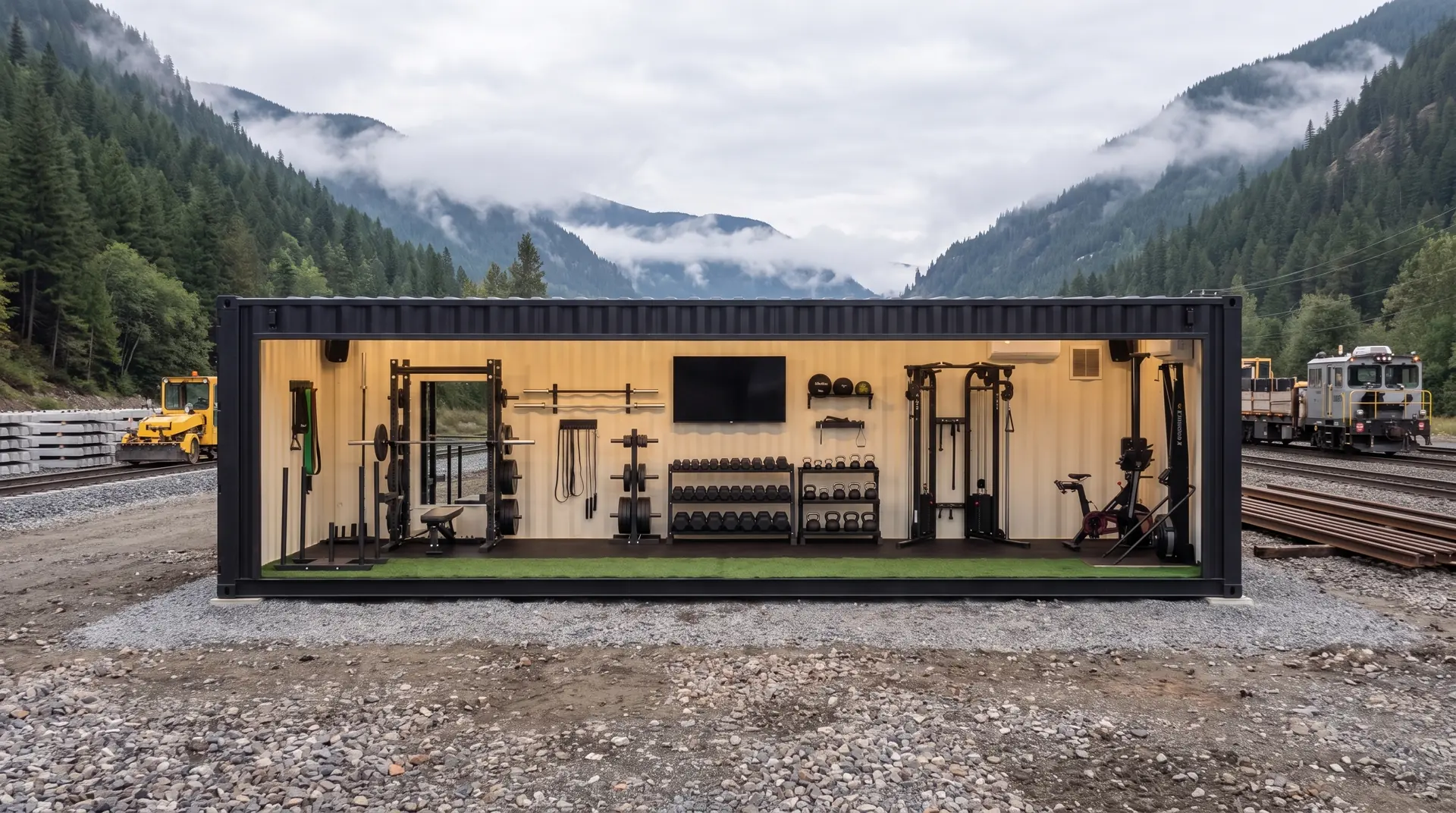
We quote the unit against a published specification, and we quote delivery and site preparation separately. People sometimes read that as evasive. It is the opposite. Rolling site costs into a headline price means padding the headline to cover the worst case, and you pay for someone else’s difficult access.
Here is what those separate lines are actually made of, so you can estimate your own site before you talk to anyone.
The four lines
The unit. Shell size, build type, finish level. This is the part we can put a number on immediately, because it does not depend on where you are. An LL-20 and an LL-40 differ by floor area, equipment count and climate capacity, not by complexity.
Freight. Distance and road access. A flatbed to a site off a provincial highway is routine. A flatbed to a site at the end of forty kilometres of gravel, in spring, is not. Winter road access changes both the cost and the calendar.
The drop. By default the unit arrives on a tilt-deck trailer and comes off straight onto the pad. The truck backs in, the deck tilts, the container slides down. It is one vehicle, one operator, and it is by far the cheapest way to do this.
A crane is the exception, not the rule. You need one when the unit is going somewhere a truck cannot reach or cannot line up with: a roof deck, a podium, over a fence, into a courtyard, onto piers that need precise placement. Crane time is billed by the day and the day is mostly setup, so this line moves a lot. Overhead power lines are the most common reason a site that looked simple needs one.
Site preparation. A levelled, compacted gravel pad or four concrete piers, plus getting a 50-amp feed to the connection point. If you have a pad and power at the location already, this line can be close to nothing. If the power has to come two hundred metres, that trench is the project.
The counterintuitive part
Getting an LL-40 to site costs roughly what getting an LL-20 costs. Same truck, same drop, same pad works, same electrical connection. You are paying for the logistics event, not for the length of the box.
Which leads to the advice we give almost everyone: unless the pad is genuinely tight or the unit has to move often, buy the 40. You double the floor for a fraction more total cost, and the cost per square foot of training space drops sharply.
The same logic applies to multiple units. Two units delivered on the same day are meaningfully cheaper than two units delivered six months apart, because you pay for one mobilisation instead of two. If you know you want a second unit, ordering both saves real money.
What makes a site cheap
In rough order of impact:
- Existing power at or near the location, ideally a 50-amp feed already run
- Firm, level ground that can be graded rather than built up
- A straight approach the trailer can back down, so the unit can be tilted off rather than lifted
- A gate and internal road a flatbed can actually navigate
- Somewhere the truck can wait without blocking operations
What makes a site expensive
- Overhead lines above the pad, which either force a crane and a lift plan or move the pad
- Soft or sloped ground needing engineered fill
- A long power run, which is trenching, conduit and an electrician
- Access that rules out a tilt-deck drop, which turns a truck job into a crane job
- Remote locations where the equipment itself has to travel a day each way
None of these are dealbreakers. They are all knowable in advance, which is the point. The worst outcome is discovering them on delivery day.
How to get a real number fast
Send three things and the estimate stops being a guess:
- The address or coordinates of the pad location
- Photos of the approach, the pad area and anything overhead
- What power exists at or near the location, and how far away it is
- Whether a flatbed can back straight up to the pad, or whether something is in the way
That is enough to tell you the range on all four lines. If your access has a problem, you will hear about it in that conversation rather than in an invoice.
Why we publish this at all
Because the alternative to a container gym is usually a capital project, and capital projects are where costs hide. A six-figure build has soft costs, design fees, permit time, a build season and a contingency that everyone pretends is not going to be spent.
Four lines, quoted honestly, with the awkward one broken out, is a shorter conversation. It is also easier to defend in a submission, which is the actual test for most of the people we talk to.
Read Next
Keep going
Specifying a Gym for a Remote Detachment
Headcount, shift pattern, power and pad, in that order. A worked example of how a detachment or a camp gets from "we need something" to a specification.
Read ItWhat to Put in an RFP for a Container Gym
Most specifications for these are written from a gym equipment catalogue, which produces bids you cannot compare. Here is what to ask for instead.
Read ItTell us about
your site.
A no-obligation call. Bring the location, the headcount and the power available.
Book a Call