Learn / Cost & Procurement
What to Put in an RFP for a Container Gym
Most specifications for these are written from a gym equipment catalogue, which produces bids you cannot compare. Here is what to ask for instead.
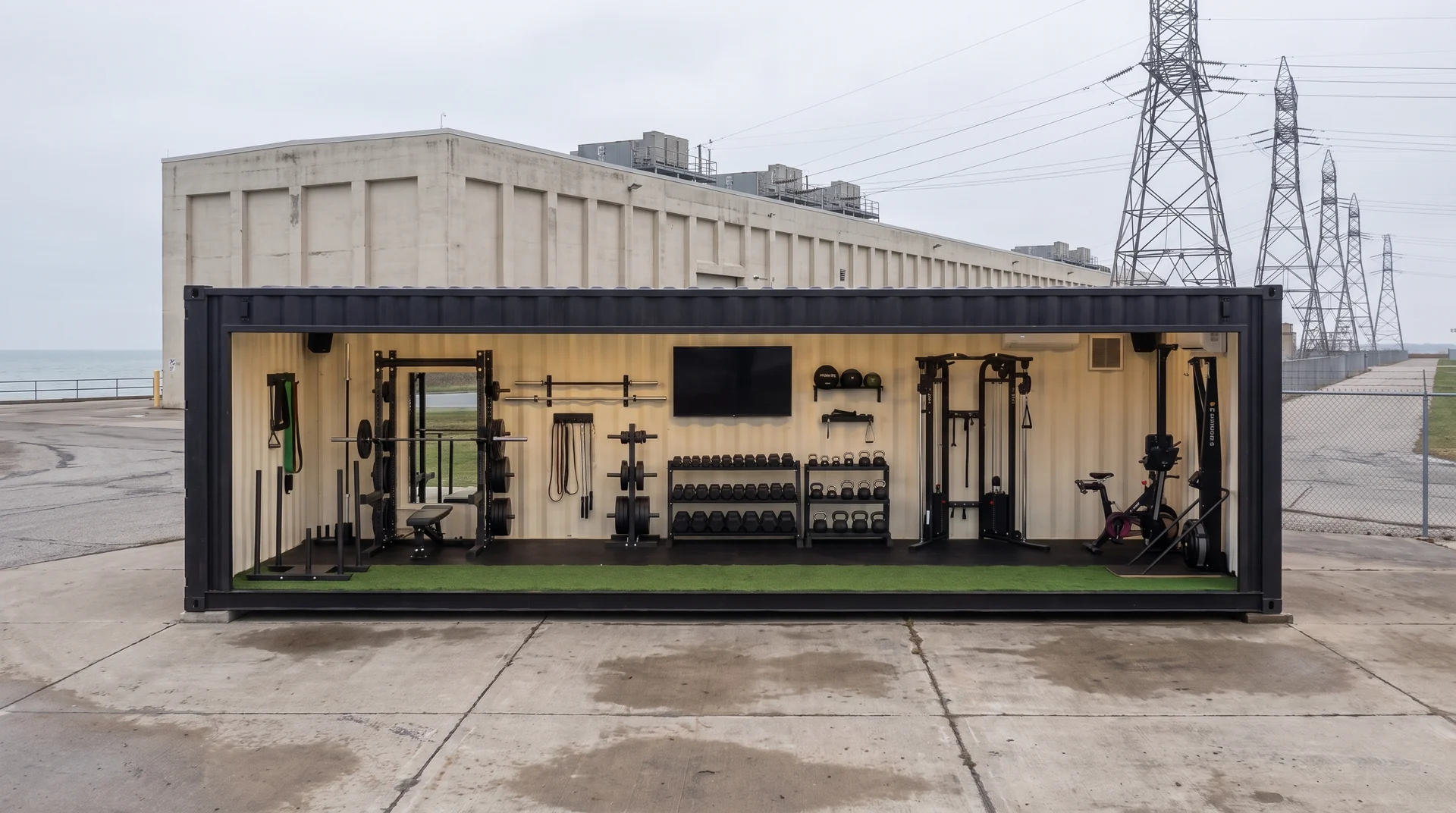
We read a lot of specifications written by people buying one of these for the first time. The commonest failure is not asking for too little. It is asking for the wrong things: a long equipment list and almost nothing about the building around it.
That produces bids you cannot compare, because the expensive parts are the parts nobody specified.
Below is what actually belongs in the document. Take any of it verbatim.
Ask about the envelope, not the equipment
Equipment is the cheap, easy, interchangeable part. The envelope is where a unit is either worth owning in February or is not.
Specify:
- Insulation type and where it goes. Closed-cell spray foam behind the walls, ceiling and floor is the meaningful answer.
- Thermal breaks at fasteners and framing. This is the question that separates serious builds from painted boxes. Steel conducts. Every stud fixed straight to the shell is a cold bridge, and a unit built without breaks will sweat and then rust from the inside.
- Vapour barrier and its continuity.
- Heating and cooling equipment, with the design temperature it holds. “Heated” is not a specification. “Holds 18 °C at an outdoor design temperature of −30 °C” is.
- Ventilation. An HRV, not just an extractor, if people are going to breathe hard in there.
Ask for the numbers your own trades will need
These are the lines that stop a project two weeks before delivery:
- Total electrical load and service size. Yours will need a feed run to the pad, and your electrician needs the number now, not later.
- Panel and circuit schedule.
- Point of connection and its location on the unit.
- Floor loading, in pounds per square foot, and the point load under a loaded rack.
- Shipping and placed weight.
- Lifting point locations and rated capacity.
- Overall dimensions including anything that protrudes.
Ask for the paperwork by name
Vague compliance language gets vague compliance. Ask for the documents:
- Structural drawings stamped by a professional engineer licensed in your province, to the applicable building code.
- Electrical certification. In Ontario that is an ESA inspection and certificate, issued before the unit leaves the shop.
- Fire and life safety provisions: smoke and CO detection, extinguisher, egress hardware.
- CSC plate or equivalent structural certification for the shell.
- Documentation package handed over at delivery.
If a bidder cannot say who is stamping the drawings, that is your answer.
Separate delivery and site preparation from the unit
Ask for them as their own lines, and ask bidders to state their assumptions. A single all-in number hides whether anyone has actually looked at your access.
Specify that bidders state:
- The delivery method assumed, tilt-deck or crane, and what site conditions that assumes
- What site preparation is included and what is excluded
- Who is responsible for the power feed to the pad
- What happens if access turns out to require a crane
That last one is the question that saves you a change order.
Ask what happens after
Almost nobody puts these in, and they are where the cost of ownership actually lives:
- Warranty terms on the shell, the mechanical equipment and the fit-out, separately
- Service and parts availability, and who attends site
- What is involved in relocating the unit, since that is the reason you bought a relocatable one
- Whether the unit can be reconfigured later, and at what cost
What not to over-specify
Resist writing an exhaustive equipment schedule. Naming specific models by brand narrows your field, invites substitution requests, and costs you more than it protects you. Specify capability instead: a rack with a certain working height, a bar and bumper set to a stated total weight, a functional trainer, two conditioning pieces. Let bidders bring their supply relationships.
The same goes for interior finishes. Specify durability and cleanability, not a product code.
The shortest version
If you only have room for five lines, use these:
- Stamped structural drawings to code, and electrical certification, both included
- Insulation, thermal break and vapour barrier described, with a stated design temperature
- Electrical load, service size and point of connection stated
- Floor loading and placed weight stated
- Delivery and site preparation quoted separately, with assumptions listed
Anything else you leave out, you can ask on a call. Those five you want in writing, from everyone, before you compare a single price.
Read Next
Keep going
How a Container Gym Gets to Site
Most units come off a tilt-deck trailer in about twenty minutes. Some need a crane. Here is how to tell which one you are, before you order.
Read ItDo You Need a Building Permit for a Container Gym in Ontario?
Usually no, because it is a relocatable structure rather than a building. But that answer depends on your municipality, and here is what decides it.
Read ItTell us about
your site.
A no-obligation call. Bring the location, the headcount and the power available.
Book a Call