Learn / Specifying
Specifying a Gym for a Remote Detachment
Headcount, shift pattern, power and pad, in that order. A worked example of how a detachment or a camp gets from "we need something" to a specification.
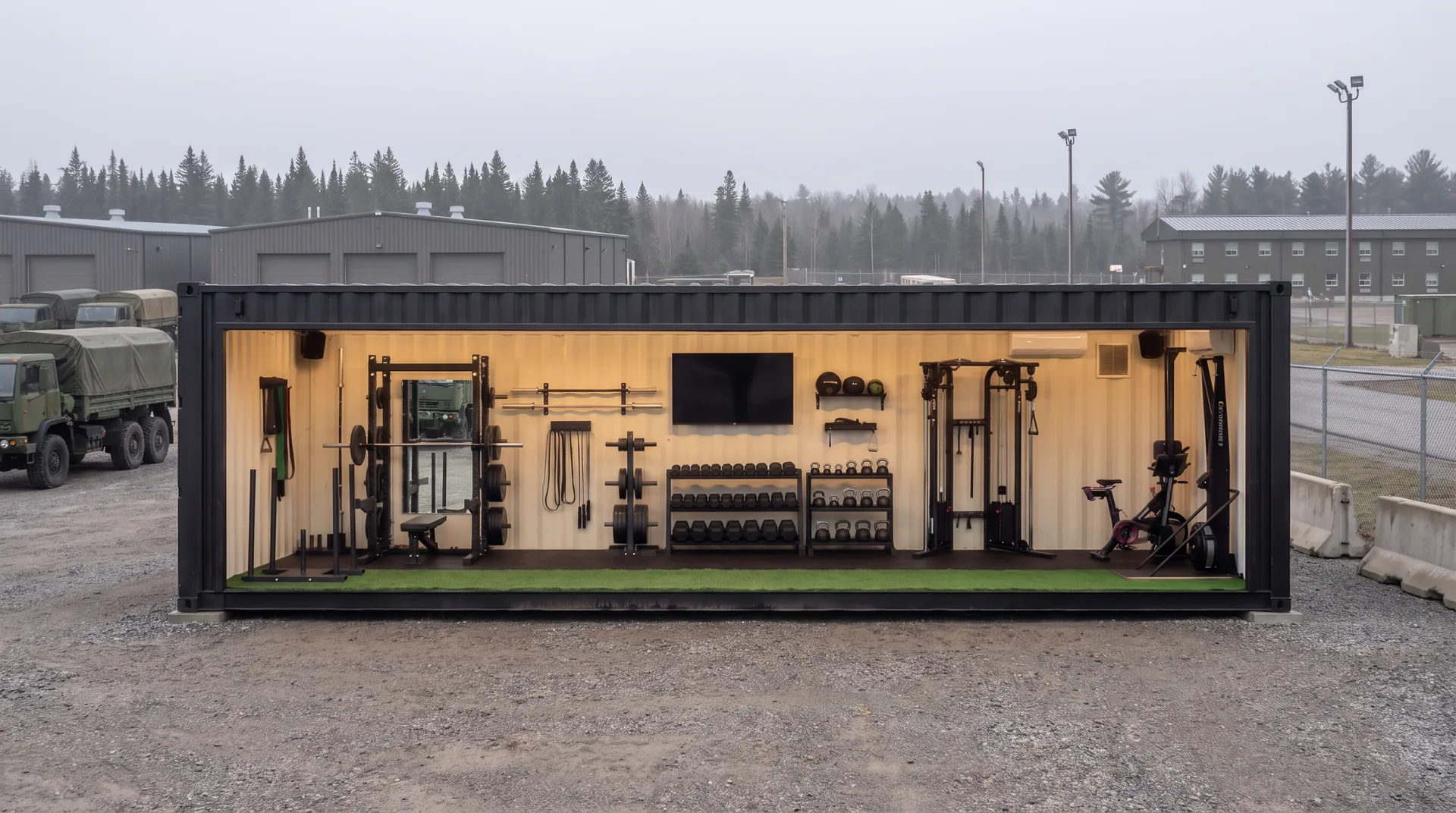
Most specification conversations start in the wrong place, with equipment. Equipment is the last decision, not the first. Work through these four in order and the specification writes itself.
1. Headcount, but the right headcount
The number that matters is not how many people are posted there. It is how many will train in the busiest hour.
For a detachment or a camp on shift rotation, that is usually a small fraction of the total. Shifts end at staggered times, some people train in the morning and some at the end of a rotation, and a meaningful percentage will not use it at all no matter what you build.
As a working rule, one LL-40 serves a population of roughly 40 to 80 people on rotation. One LL-20 serves 15 to 30. Those ranges assume normal usage patterns, not a mandated fitness parade where everyone arrives at once.
If your population genuinely does finish at the same time, that is the exception, and the answer is two units rather than one bigger one.
2. The shift pattern, which decides the build type
Three build types, and the shift pattern picks for you.
Weight-heavy suits small, consistent groups who train regularly and know what they are doing. Racks, free weights, benches, wall storage. This is what most defence and worksite buyers ask for, and usually they are right.
Cardio-heavy suits high throughput and mixed ability. Rowers, bikes, ski ergs, kettlebells, a short sled track. If people have thirty minutes between the end of a shift and dinner, and they range from very fit to not, this moves more people through.
Balanced is the default for a reason. A rack and bench at one end, rower and bike at the other, storage down the wall. If you cannot decide, or the population is genuinely mixed, take this.
The layouts are all drawn to scale before you order, so this is a decision you make by looking at a drawing rather than by imagining it.
3. Power, which is where projects stall
A unit needs 50 amps at 240 volts. That covers the panel, the lighting, the heat pump and the equipment.
Three questions, in order of how often they cause a delay:
Is there capacity? Not “is there power at the site” but “is there 50 amps spare at the panel you plan to feed from.” On older detachments and mature camps the answer is often no, and adding capacity is a bigger job than putting the gym in.
How far away is it? The trench and the conduit are frequently the largest single line in site preparation. Twenty metres is nothing. Two hundred metres is a project.
Is it a generator? A genset is fine, and many worksite units run on one. The heat pump is the load that matters in winter, so size the generator for the unit rather than assuming the spare capacity will do.
If the honest answer is that power is hard, say so early. It changes the pad location more often than it changes the unit.
4. The pad, which is usually the easy part
A levelled, compacted gravel pad, or four concrete piers at the corners. No foundation, no excavation.
What to look at when you pick the location:
- Overhead lines above it, which is the most common reason a pad moves
- Ground that will take a crane’s outriggers on the day
- Where the snow gets pushed, because you do not want the door buried in February
- Distance to power, from point 3
- Whether it is inside the secure perimeter, because that decides your access control conversation
What the specification ends up looking like
For a northern detachment of about sixty members, working rotations, with an existing 50-amp feed forty metres from a gravel area inside the compound, the specification is: LL-40, four-season envelope, weight-heavy build, liveried finish, access control tied to the existing system, set up on a levelled pad with a forty-metre power run.
That is a page. It is reviewable in one sitting, it prices against a published specification, and it lands six to eight weeks after the order.
The version of this conversation that goes badly is the one that starts with a wish list of equipment and works backwards to discover there is no power. Start with the headcount, then the shifts, then the power, then the pad.
If you want to skip to the end, see how this plays out for defence and policing, or bring the four answers to a call and we will write the specification with you.
Read Next
Keep going
What to Put in an RFP for a Container Gym
Most specifications for these are written from a gym equipment catalogue, which produces bids you cannot compare. Here is what to ask for instead.
Read ItHow a Container Gym Gets to Site
Most units come off a tilt-deck trailer in about twenty minutes. Some need a crane. Here is how to tell which one you are, before you order.
Read ItTell us about
your site.
A no-obligation call. Bring the location, the headcount and the power available.
Book a Call