Learn / Delivery & Set Up
How a Container Gym Gets to Site
Most units come off a tilt-deck trailer in about twenty minutes. Some need a crane. Here is how to tell which one you are, before you order.
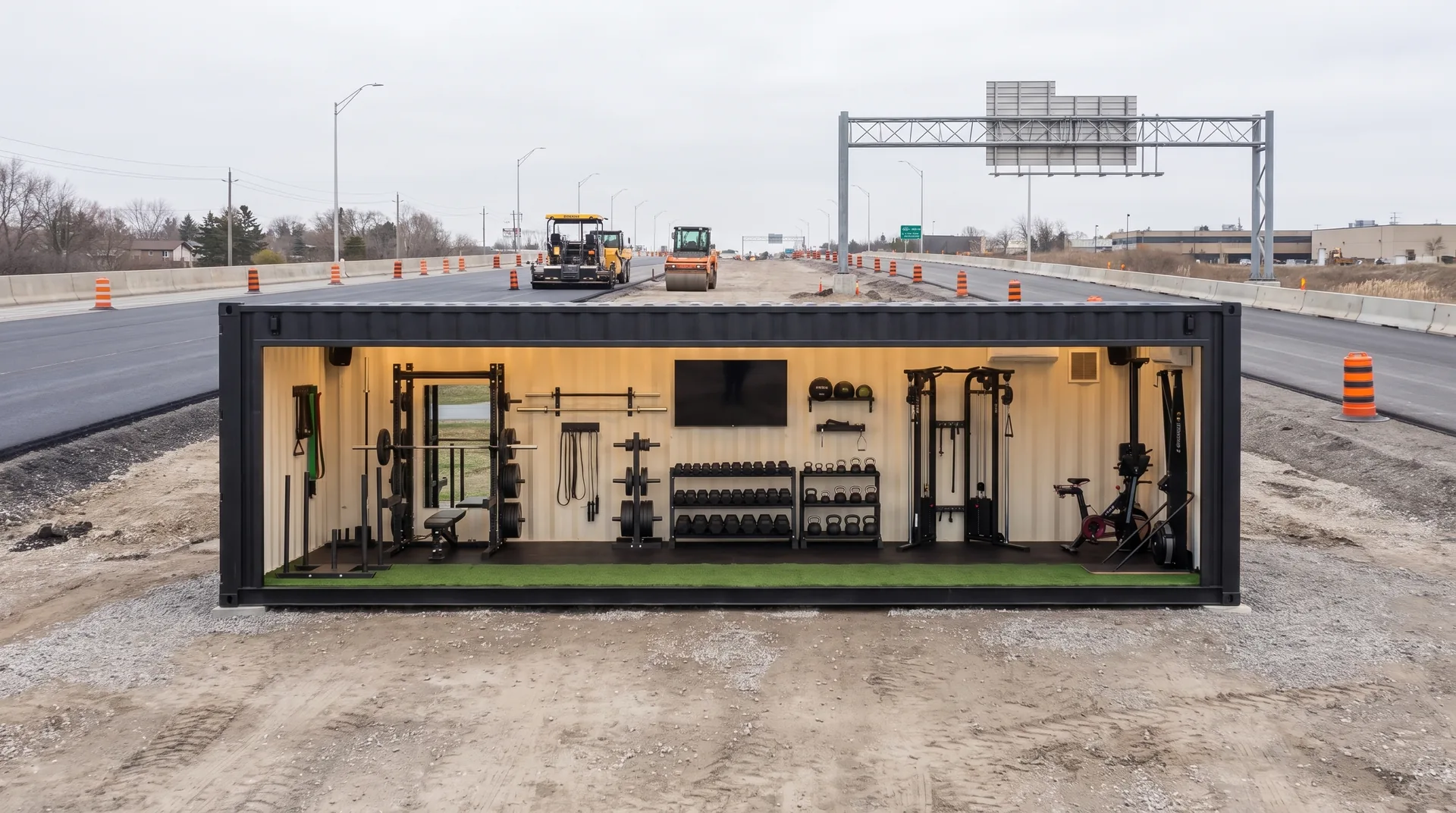
Delivery day is the part people picture going wrong. It rarely does, but the reason it rarely does is that the awkward questions get asked weeks earlier. Here is the whole process, and the four things that decide whether yours is simple or expensive.
The default: tilt and drop
A tilt-deck trailer is a flatbed whose deck pivots. The driver backs up to the pad, the deck tilts, and the container slides down onto the ground on rollers or skids. One truck, one operator, no lifting equipment.
This is how most units get placed, and it should be your assumption unless something on your site rules it out. It is the fastest option and by a wide margin the cheapest, because you are paying for a truck and a driver rather than a crane, a crew and a lift plan.
The whole placement takes under half an hour once the truck is lined up. Most of delivery day is driving.
What tilt-and-drop needs from your site
Four things, and you can check all of them yourself:
A straight approach. The trailer needs to reverse in line with the pad, because the container slides backwards off the deck. It cannot be placed sideways or swung into position. Roughly a truck length and a half of clear, reasonably straight run behind the pad is the practical test.
Ground that will take a loaded trailer. Soft ground, deep mud or fresh fill are the usual problems. Gravel is ideal. If a concrete truck could get there, so can this.
No obstruction overhead on the approach. Low branches and low wires along the route matter as much as anything above the pad itself.
Room for the truck to leave. Sounds obvious. It is the thing most often forgotten on a fenced compound with one gate.
When you need a crane instead
Four situations, and they are all knowable in advance:
- The unit is going up. Roof decks, podium levels, anything above grade. This is the common one in multi-residential.
- The truck cannot line up with the pad. Courtyards, tight yards, anywhere the approach is at an angle you cannot fix.
- Something is in the way. A fence that cannot come down, an overhead line above the pad, a building in the approach.
- The unit is going onto piers. Piers need the container set down accurately in both directions rather than slid into place.
A crane is not a failure. It is a line item. But it is a meaningfully larger line item, because crane time is billed by the day, the day is mostly setup, and a lift over anything sensitive brings a lift plan and a supervisor with it. Knowing which category you are in before you order is worth more than any other single thing you can do to control delivery cost.
What happens on the day
- The truck arrives. If it is a crane job, the crane and its crew arrive first and set up.
- The unit is placed and levelled on the pad or piers. Shims where the ground is not perfect.
- It is tied down or secured per the drawings.
- Electrical is connected to the point your electrician has already brought to the pad.
- Everything is commissioned: heat pump, HRV, lighting, outlets, detection.
- Handover. Keys, drawings, ESA certificate, equipment documentation.
Training that afternoon is normal, not marketing.
The two mistakes worth avoiding
Leaving power to delivery day. The single most common cause of a unit sitting unusable for a fortnight is that the feed to the pad was not run in advance. It is the one part of this that is genuinely on your side of the line, and it needs an electrician and, depending on the site, an inspection window.
Not looking up. Overhead lines are the most expensive four seconds of not-looking in this whole process. Photograph the pad and the approach, including straight up, and send them when you enquire.
The one question to answer before you order
Can a flatbed reverse straight up to where the unit is going?
If yes, you are a tilt-and-drop job and delivery is a truck. If no, you are a crane job and it should be priced that way from the start. Everything else about delivery follows from that answer.
Read Next
Keep going
Do You Need a Building Permit for a Container Gym in Ontario?
Usually no, because it is a relocatable structure rather than a building. But that answer depends on your municipality, and here is what decides it.
Read ItWhat It Costs to Get a Container Gym on Site
The unit is the easy number. Freight, the drop, the pad and the power are the lines that move, and here is what makes each of them expensive.
Read ItTell us about
your site.
A no-obligation call. Bring the location, the headcount and the power available.
Book a Call